


The Seiko Pogue: The $71 Watch That Went to Skylab
In June 1972, William Pogue paid $71 for a Seiko chronograph he’d put on layaway. About seventeen months later, it was tucked into a pocket of his spacesuit as he prepared to launch to America’s first space station. The receipt survived. So did the watch.

A watch he already knew
Pogue had used his Seiko 6139 during training to time engine burns. By launch day, he knew how to read it and how the pushers felt. Once in orbit, he put it on his left wrist and set it to US Central Time. His NASA-issued Omega went on his right. Two watches, each with a place in his day. Pogue’s watch and accompanying records.
Skylab 4 lifted off on 16 November 1973. Pogue, mission commander Gerald Carr and science pilot Edward Gibson spent 84 days in space, carrying out experiments and observing the Sun and Earth before splashing down in February 1974. A NASA photograph from the mission catches a lighter moment. Carr balances an upside-down Pogue on one finger, putting on a little weightlifting show in weightlessness. NASA’s Skylab 4 mission history.

Two later Seikos with a familiar look
Look at the gold dial and red-and-blue bezel on the Seiko 7A28-7030 and you can see why it’s often called the ‘Quartz Pogue’. It’s an early-1980s watch with three subdials and a battery-powered quartz movement. Pogue’s own 6139 was a mechanical automatic. The resemblance is easiest to see from across a room. Up close, the dial tells you which watch you’re looking at. Seiko 7A28-7030 auction photographs.

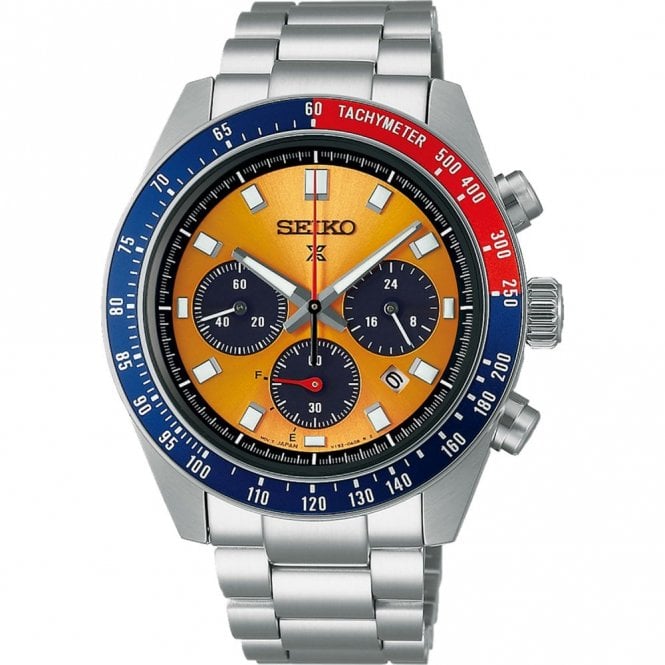
Then there’s the modern Seiko Prospex Speedtimer Solar Chronograph, reference SSC947. The yellow dial and red-and-blue bezel bring the old colour scheme back, with dark subdials that give the watch a different look on the wrist. Its V192 quartz movement charges from light and runs for about six months on a full charge. It’s a way to enjoy those colours in a modern Seiko, even if the one you really want is still the old automatic. See the Solar Pogue and its product photos at Hillier Jewellers.
The Pogue timeline
- 1972 — William Pogue buys his automatic Seiko 6139 for $71 and uses it during training.
- 1973–74 — Pogue wears his Seiko aboard Skylab 4 during the crew’s 84-day mission.
- Early 1980s — The gold-dial Seiko 7A28-7030 brings a similar look to a battery-powered quartz chronograph. Collectors call it the Quartz Pogue.
- 2008 — Pogue’s own Seiko sells at auction, accompanied by his receipt and handwritten account.
- 2024 — The Prospex Speedtimer Solar SSC947 brings back the yellow dial and red-and-blue bezel with a solar quartz movement.
The Seiko that came home
The gold dial and red-and-blue bezel are what catch your eye first. The stopwatch is what connects the watch to Pogue’s story. You can see why collectors took to calling the gold-dial 6139 a ‘Pogue’. The nickname gives a familiar vintage Seiko a very specific human association.
My favourite part of the story comes after splashdown. Pogue kept wearing his Seiko for years, retiring it in 2003. When it sold at auction in 2008, the lot included his layaway receipt and a handwritten letter telling its story. That little receipt might be the best detail of all. Before the Seiko spent 84 days in space, it was a watch someone put money aside for, bought, and wore because he liked using it. Heritage Auctions archive.


